The two-part model
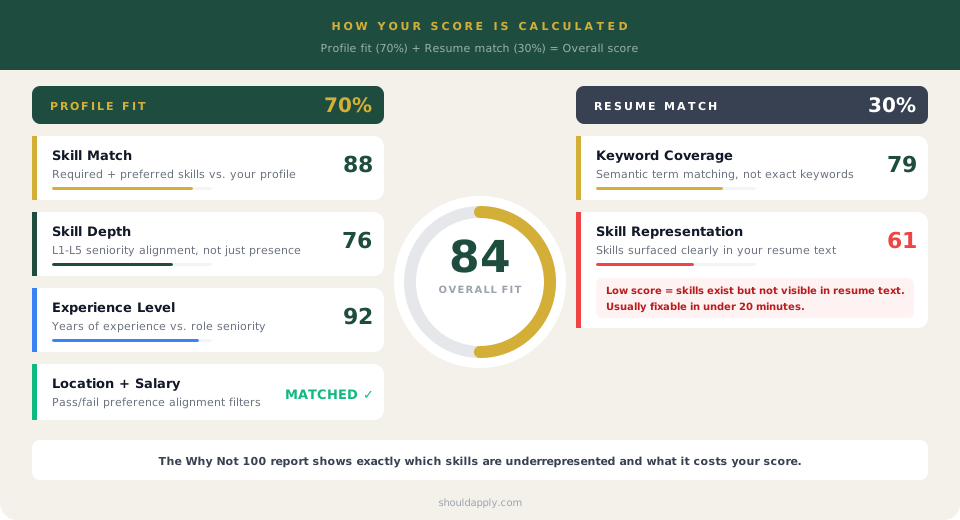
Your overall score is a weighted composite of two things: how well your actual profile matches the job, and how well your resume communicates that match. Profile fit is weighted higher because it reflects reality.
Who you actually are
Your skills, experience depth, seniority level, location, and salary expectations versus what the role requires.
How clearly your resume says it
How well your resume text communicates your profile. A strong profile with a weak resume loses points here. The fix is usually 20 minutes.
Why this weighting matters: A recruiter's first question is always "is this person qualified?" Not "does their resume have the right keywords." Profile fit is weighted higher because it reflects reality. A low resume match score usually means your skills are not surfaced in your resume text, not that you are a bad fit.
The five scoring dimensions
Each dimension contributes independently. You see every sub-score in your dashboard alongside the overall number.
Skill match
Core of profile fitEvery skill in the JD, required and preferred, is mapped against your profile. Required skills weight heavier. The engine reads phrasing to figure out which is which, even when the JD does not say so explicitly.
Skill depth
Biggest differentiatorHaving a skill is not enough. The L1–L5 depth has to match what the role actually needs. SQL at L2 and SQL at L5 are different qualifications. Depth gaps are the biggest input to your Why Not 100 breakdown.
Experience level
Seniority alignmentYears of experience, trajectory, and seniority signals from your work history are matched against the role. Inflated titles get caught by language analysis, not just the job title.
Location and salary
Pass/fail filtersLocation and salary are threshold filters. Outside your geographic range with no remote, or below your minimum salary, caps your overall score regardless of how strong the skill match is.
Job quality signals
Posting healthPosting age, salary transparency, and JD quality contribute to a separate quality sub-score. Stale or ghost postings get flagged alongside your fit score so you can factor them in before applying.
Reading your score
The number is a starting point, not the decision. Here is what each range usually means and what to do about it.
Apply immediately and prioritize this role. Profile and resume both align closely. Spend the time on a real cover letter.
Worth applying. One or two addressable gaps. The Why Not 100 breakdown shows which are fixable before you submit.
The gaps are real but may not be disqualifying. Check whether they sit in required or preferred skills. A fresh posting here is worth a targeted application.
Better invested in higher-fit roles. Unless something compensates, your odds improve a lot with a better-matched role.
Move on. The gaps across core dimensions are too large to overcome through application strategy.
Go Deeper
Frequently Asked Questions
Why is profile fit weighted more than resume match?
A recruiter assessing your application is trying to evaluate your actual fit, not just whether your resume has the right words. A strong profile with a mediocre resume will still generate interviews. A perfectly optimized resume for a role you are not suited for creates bad outcomes for everyone.
What if my resume match score is low but my profile fit is high?
That is the most common fixable gap. It means you have the skills and experience but your resume does not surface them in a way that maps to what the JD is asking for. The Why Not 100 breakdown shows specifically which skills are underrepresented in your resume text.
Does the score change if I update my profile?
Yes. Your profile is re-scored whenever you update your skills or resume. The score input hash system means we only recalculate when something actually changes, so your scores stay current without unnecessary API calls.
How is this different from ATS keyword matching?
ATS matching checks if specific words appear in your resume. The ShouldApply engine understands meaning: it knows that managed cross-functional teams and led interdisciplinary groups describe the same competency. It also evaluates depth, seniority alignment, and job quality signals that keyword matching completely ignores.
See it on a real job.
Run a free score on any job posting and get the full breakdown: profile fit, resume match, Why Not 100 gaps, and job quality signals.
Get Your Free Score